
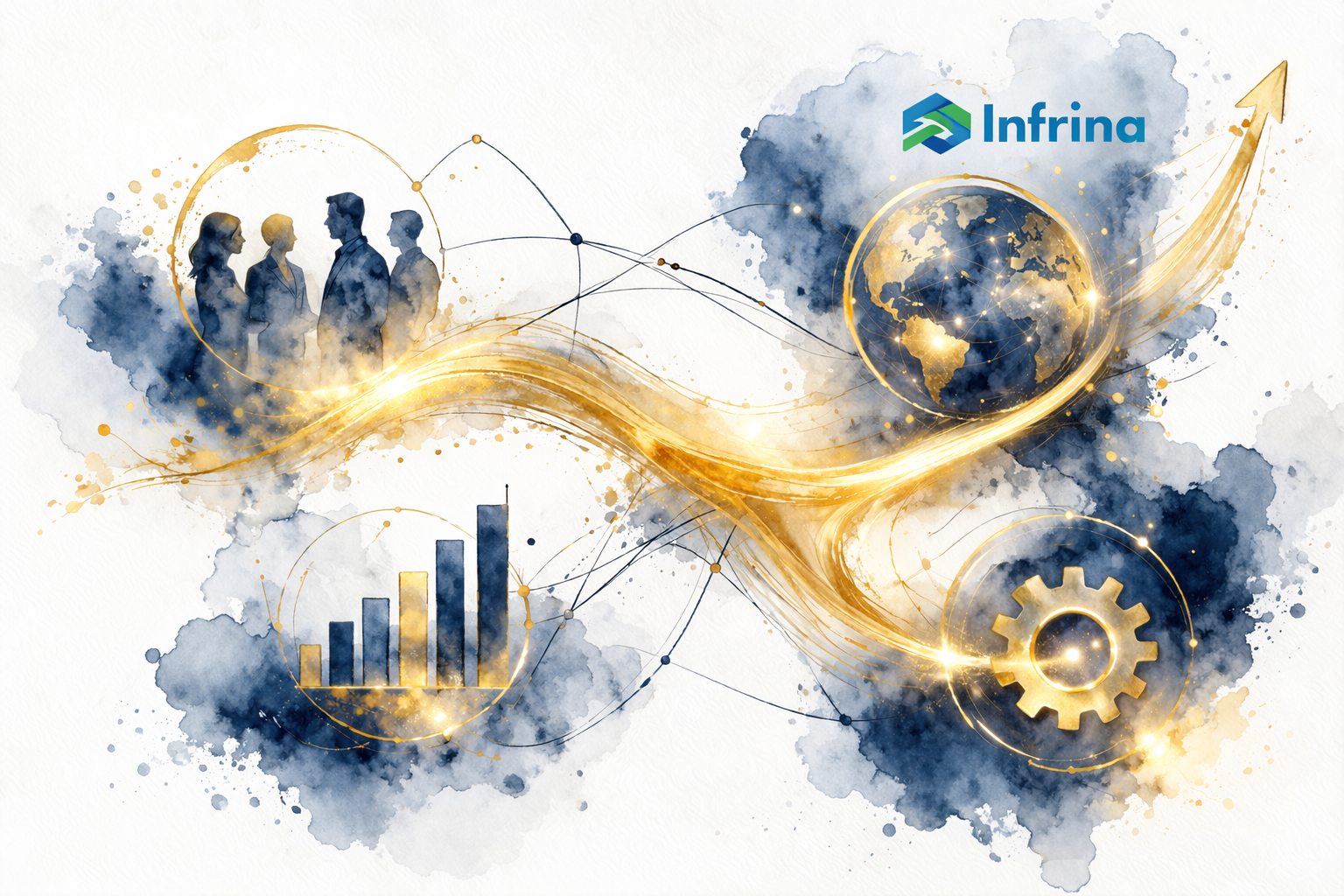
In the modern enterprise, competitive advantage is no longer a matter of manual effort; it is a matter of algorithmic velocity. We have entered an era where the divide between market leaders and stagnant firms is defined by how effectively they integrate Artificial Intelligence into their core architecture.
At Infrina, we observe that the most successful organizations view AI not as a peripheral "plugin," but as a fundamental performance multiplier. When implemented with precision, AI transitions a company from a reactive state—solving problems after they occur—to a proactive state of predictive growth.
Here is an analysis of the four pillars where AI is currently redefining the benchmarks of business excellence.
1. Professional Assistance: Eliminating the "Administrative Tax"
Administrative friction is one of the most significant hidden costs in professional services. Research suggests that the average executive spends approximately 40% of their workday on non-strategic administrative tasks.
AI-powered professional assistance acts as a high-speed filter for this "administrative tax." By automating complex scheduling, intelligent document synthesis, and communication sorting, AI recovers hundreds of billable hours per year. According to data from the Harvard Business Review, organizations that deploy AI for administrative support report a 20% increase in overall team output without increasing headcount. It allows human talent to focus on high-stakes, creative, and empathetic problem-solving.
2. Strategic Human Resources (HR) Management
Human capital is the most expensive and volatile asset in any organization. AI is revolutionizing the lifecycle of the employee, from acquisition to long-term retention.
Bias-Free Recruitment: AI algorithms process thousands of applications in seconds, focusing strictly on skill-matching and behavioral fit. This has been shown to reduce "Time-to-Hire" by an average of 35%, significantly lowering recruitment costs.
Predictive Retention: By analyzing engagement patterns and internal communication metadata (anonymized), AI can identify "turnover risk" long before an employee submits a resignation. This allows HR leaders to intervene strategically, preserving organizational knowledge and reducing the high cost of attrition.
3. Data Integration and the "Single Source of Truth"
The primary obstacle to modern business intelligence is the "Data Silo." Most firms have valuable data trapped in disparate systems—CRM, accounting, and marketing platforms—that do not communicate with each other.
AI serves as the connective tissue. By integrating these disconnected streams, AI creates a unified data ecosystem. Once this integration is achieved, the system moves beyond reporting the past and begins predicting the future.
Customer Prediction: Businesses leveraging predictive customer analytics are 2.5 times more likely to outperform their competitors in sales growth and customer lifetime value (CLV). AI identifies exactly which customers are ready for an upsell and which are showing signs of "churn."
4. Precision in E-Commerce and Digital Retail
In the high-velocity world of e-commerce, AI is the engine behind profitability. It optimizes the three most critical variables of retail:
Hyper-Personalization: AI analyzes real-time user behavior to serve personalized product recommendations. This level of precision typically lifts conversion rates and total sales by 10-15%.
Inventory Intelligence: Algorithms predict demand spikes with over 90% accuracy, preventing the twin costs of overstocking and "out-of-stock" lost revenue.
Dynamic Pricing: In competitive markets, AI adjusts pricing in real-time based on inventory levels, competitor moves, and demand elasticity, ensuring margins are protected automatically.
Infrina: Your Architect for Integrated Intelligence
The potential of AI is immense, but the risk of "disjointed implementation" is high. Many firms fail because they purchase isolated AI tools that do not talk to their existing systems.
At Infrina, we specialize in Integrated AI Strategy. We don’t just provide tools; we build the bridges between your current infrastructure and the future of your business. Whether you are looking to automate HR workflows, integrate fragmented data for predictive insights, or optimize your e-commerce engine, we ensure the technology is a seamless extension of your professional identity.
The "Algorithmic Edge" is available to those who choose to integrate rather than just implement.
Are you ready to redefine your performance standards?